A history
Coffee enemas appear in medical publications from well before the modern wellness movement. Understanding that history gives the practice its proper context.
 Shop
Coffee enema education · High Vibes Health Collective
A documented history. Passionate practitioner advocates. People seeking relief, clarity, and a more hands-on relationship with their health. Coffee enemas deserve a thoughtful conversation—and this is where we go deeper.
Coffee enemas appear in medical publications from well before the modern wellness movement. Understanding that history gives the practice its proper context.
Relief, renewed energy, and clearer thinking feature in practitioner and customer accounts. Listening to those experiences is part of understanding the appeal.
Rejuva Jar keeps the equipment visible and understandable. Rejuva Roast brings the coffee. Education connects the product to an informed choice.
The Rejuva Jar point of view
A practice with a history, a community, and questions worth exploring in depth. Learning the route, the equipment, and your own response turns curiosity into body literacy.

Understand the process.
Keep the person in view.
A coffee enema introduces a prepared coffee solution into the rectum. It combines the local action of an enema with exposure to coffee compounds through a route different from drinking it. The practice became closely associated with nutritional and detoxification programs, but its medical history reaches further back.
In her 2021 Coffee Enemas: A Narrative Review, physician Linda Isaacs describes patients reporting relief from constipation, fatigue, mental fogginess, headaches, and muscle or joint discomfort. Her review brings those day-to-day patient observations into the practice's written record. Read the practitioner review ↗
A documented past
Enemas have an ancient history; coffee enemas are a later chapter. Follow the published landmarks from nineteenth-century medical accounts to today's practitioner writing and human research.
John Parmenter’s 1897 surgical review and a 1901 nursing publication discuss coffee enemas in the medical practice of their time—well before the modern detox movement. These documents record the practice in their own era. Read them as medical history. Use current instructions and qualified guidance for present-day care.
1897 journal record ↗1901 nursing record ↗Max Gerson’s book A Cancer Therapy: Results of Fifty Cases documented the nutritional program with which coffee enemas became strongly associated. That history explains their place in holistic-health culture. Read the book as a record of that program; cancer-treatment decisions require clinical evidence and qualified oncology care.
The original book record ↗A 42-patient report followed constipation and bowel-frequency scores over a month and reported improvement. The report followed a single patient group, giving an encouraging observation to explore through controlled research.
Open the study notes ↓Researchers investigated antioxidant markers, caffeine absorption, and preparation for capsule-camera examinations. These studies asked different questions; their findings belong in the story on their own terms.
Explore the body pathways ↓Linda Isaacs published a narrative review bringing together her clinical experience, historical publications, coffee chemistry, and practical care considerations.
Read her review ↗The relief conversation
Elimination, energy, focus, comfort, and whole-body wellness are why people ask about coffee enemas. Open a topic to see the experience, the idea behind it, and the context that makes it useful.
Study observationPractitioner / customer reportTraditional wellness question
Early human observation + general enema action
When difficult bowel emptying is the problem, a successful bowel movement can make a meaningful difference to comfort. Enemas have a recognized role in selected constipation care. The 2005 coffee-enema report also described improvements in constipation and bowel-frequency scores in its 42-patient group. It followed one group without a comparison arm.
See the 42-patient study ↓Customer experience
A customer account published by Rejuva Jar describes greater energy, less fogginess, and improved focus after using the system. These personal observations are part of the experience behind Rejuva Jar. Persistent fatigue or concentration changes deserve their own assessment.
Read the customer perspective ↓Practitioner report
In her practitioner review, Isaacs describes patients reporting relief from headaches and muscle or joint discomfort. These accounts make everyday comfort part of the coffee-enema conversation. New, severe, or persistent symptoms still call for assessment.
Explore the reported experiences ↗Personal goal + body awareness
A calm setting, privacy, and time to pay attention to comfort are part of the experience people seek. The useful goal is awareness: noticing urge, pressure, energy, and how you feel afterward. Relaxation should never require forcing flow, tolerating pain, or holding longer than is comfortable.
Explore attentive use + care →Traditional rationale
Wilson's explanation connects coffee enemas with bile-related elimination. Explore that practitioner rationale and the liver's normal digestive role.
Follow the liver + bile discussion ↓Wider wellness questions
Whole-body wellbeing brings people to the practice. Starter Kit buyer Sadie described a positive skin change and a more positive relationship with her body in an account published by Rejuva Jar. Her experience belongs in the personal-story conversation; infection and immune conditions still need their own care.
Explore the wider relief directory →Wider wellness questions
Comfort after eating, restful sleep, and appetite patterns matter to everyday life. They remain central questions in Rejuva Jar education. Notice how comfort, rest, and appetite feel in your own day. Caffeine sensitivity deserves attention, particularly when sleep or palpitations are an issue.
Continue with focused questions →Personal experience + body awareness
A sense of release can change how a day feels. Customer accounts describe body confidence alongside the practical appeal of a visible glass system. Give those experiences room: learn the process, notice your response, and keep comfort and care at the center.
Understand the physiology →Understand the explanation
The practice brings several body processes into the conversation. Knowing what each one does makes the traditional explanation—and the research—easier to follow.
Liquid in the rectum can create the urge to evacuate.
Caffeine can be absorbed through the rectal route.
Advocates propose effects on bile and detoxification.
The rectum is the final holding area before a bowel movement. Filling it can engage the urge to go; some enema formulations also soften stool or draw in water. That local effect explains why an appropriate enema may help selected constipation situations. Match ongoing bloating or discomfort to care that addresses its particular cause.
Bowel-function education ↗A 2013 crossover study in 11 healthy men measured caffeine after coffee was given orally or rectally. Systemic exposure was lower with the enema under those study conditions. The measurements show that rectally administered caffeine can reach the bloodstream. That systemic exposure deserves attention, especially for anyone sensitive to caffeine.
Read the caffeine study ↗The liver makes bile; the gallbladder stores it and releases it into the small intestine, where it helps with fat digestion. Advocates propose that coffee enemas encourage bile-related waste elimination. The 2014 imaging pilot found clearer fluid in parts of the small bowel. The authors left the bile-excretion mechanism for further investigation.
Follow the normal digestive pathway ↗Your digestive tract has its own nerve network, and it communicates with your brain in both directions. Our plain-language guide connects bowel comfort, body awareness, and the coffee-enema experience.
Meet the gut–brain connection →GSH is glutathione; GST names the enzymes that use it. Our dedicated guide introduces the cellular chemistry, coffee compounds, and practitioner perspective.
Explore glutathione + the coffee connection →Care is part of the knowledge
Let knowledge and comfort lead. Understand the equipment, confirm whether the practice is appropriate for you, and stay attentive to what your body is telling you.
Discuss persistent symptoms, bowel disease, surgery, pregnancy, medicines, and caffeine sensitivity with a qualified clinician before considering use.
Use current product instructions. Preparation, filtration, dilution, cleanliness, and temperature matter. Hot liquid can burn bowel tissue.
Never force insertion, flow, or retention. Pain, resistance, bleeding, dizziness, palpitations, or distress mean stop.
Clean, rinse, dry, and inspect reusable components as directed. Keep body-contact parts personal and replace worn or damaged items.
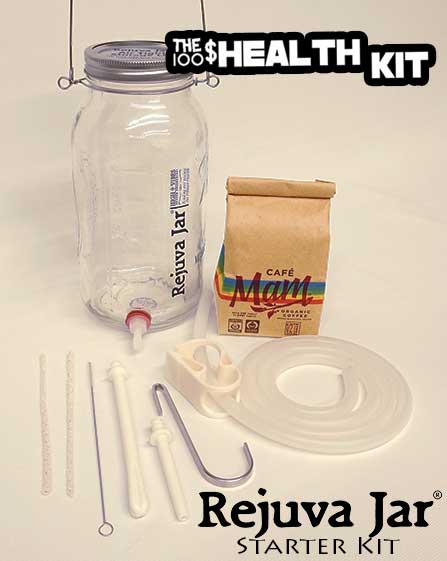
Rejuva Jar × Rejuva Roast
Meet the reusable glass system, then explore Rejuva Roast: organic, shade-grown whole bean coffee purpose-roasted for coffee enema preparation. The official shop carries coffee and subscription options.
Explore the research
Explore studies of constipation, capsule-camera preparation, antioxidant markers, and caffeine absorption. Open a study for its results, methods, and practical context, or continue into the practitioner review.
What was observed: Forty-two patients were assessed before treatment and again at one week and one month. The authors reported improved constipation and bowel-frequency scores and moderate satisfaction.
Study scope: This before-and-after report followed one group. Separating coffee's effect from the enema, other changes, or expectation calls for a controlled comparison. Nausea and abdominal distension were reported. Read the observations alongside individual suitability and the need for further research.
Kim, Lee & Song · The Effect of Coffee Enema on Constipation ↗What was observed: In a 34-patient capsule-endoscopy study, 17 patients received a coffee enema alongside oral polyethylene glycol preparation and 17 received that preparation alone. The combination produced clearer fluid in parts of the small bowel; no coffee-enema-related symptoms were reported in the treated group during the short follow-up.
Study scope: The study focused on a single procedure-preparation setting. Systemic effects, long-term safety, and home use call for their own research. The bile-excretion explanation remained open for further investigation.
Kim and colleagues · Capsule-endoscopy pilot ↗Two small crossover studies examined different questions in healthy male volunteers. Serum glutathione remained similar under the tested regimen in the antioxidant study. The caffeine study showed that the rectal route still produces systemic caffeine exposure. Those are specific measurements of blood markers and caffeine exposure, rather than tests of every wellness outcome described by users.
2012 antioxidant study ↗Isaacs’s 2021 narrative review brings the practitioner perspective into the written record through patient observations, history, and practical considerations.
Keep the preparation and safety guidance alongside practitioner observations. Read the use + care guide →
Keep learning
Explore the relief directory, see the Rejuva Jar components, or open the use-and-care guide.